

I’ll be real with you – I almost missed a job interview because of a Windows update.
I hit Shut Down, walked away to grab my jacket, came back, and found my laptop sitting at a blue screen with a spinning circle and the words “Working on updates. 34%.” I had 12 minutes to leave. Long story short – I made it, but barely. And that was years ago. I’ve been low-key annoyed about it ever since.
So, when I saw Microsoft’s announcement this week, I actually stopped scrolling. They’re changing how Windows 11 handles shutdowns and restarts and for once, the changes are genuinely useful. No new AI sidebar. No redesigned Start menu nobody asked for. Just: click Shut Down, PC shuts down. That’s it.
Let me walk you through exactly what Microsoft changed, why it matters, and when you can expect it on your machine.
Wait: Why Has This Been a Problem for So Long?
Good question, honestly. The forced update-on-shutdown thing started back with Windows 10 in 2015, when Microsoft decided updates would be mandatory. Before that, you could delay them basically forever — which caused its own problems, since a lot of people just never updated and ran vulnerable systems. So, Microsoft swung hard in the other direction.
The result? Updates started kidnapping your arrestment button. You’d click renew and rather get a 45- nanosecond update session. You’d break updates, hit the limit, and Windows would principally go” okay, time’s over” and force them anyway. You’d see three different motorist updates in a week, each taking its own reboot.
Microsoft says they read through 7,621 pieces of stoner feedback before making these changes. And to their credit, you can tell – because the fixes are ray concentrated on the two effects people complained about utmost surprise updates and not enough control.
Read More: WhatsApp Plus for 229 PKR – Is It Actually Worth It? (2026)
Here’s What’s Actually Changing in Windows 11
There are four changes in this update. None of them are complicated. All of them are effects you are going to appreciate.
Change# 1: Shut Down Actually Shuts Down Now
The Power menu is getting a proper redesign. Instead of “Shut Down” secretly meaning “install pending updates then shut down,” you’ll now see four clearly labeled options:
- Shut Down: just powers off your machine, full stop
- Restart: reboots, nothing more
- Update and Shut Down: when you’re ready, and you choose it
- Update and restart: same deal but reboots after
The update options only show up when there are actually updates waiting. When there aren’t? You’ll just see Shut Down and Restart. Clean, simple, predictable.
Also and this part’s nice after a normal restart (no update), Windows will now try to reload your previously open apps faster. So, if you had six browser tabs and a Word doc open, it’ll try to bring those back quicker than before.
Change# 2: You Can Break Updates on Your Own Terms
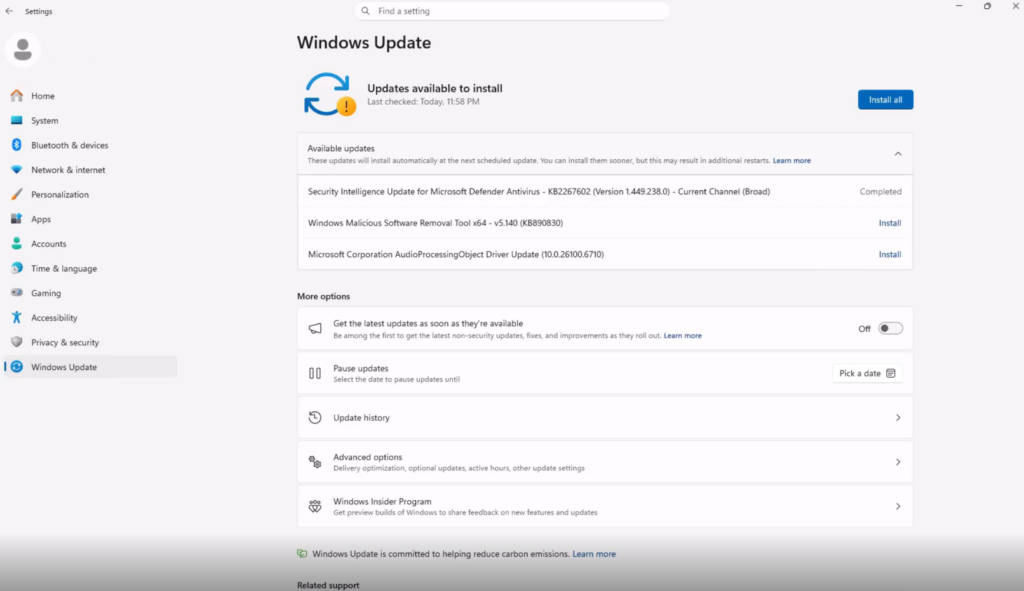
The current pause feature is kind of a joke. You pause for a week, it expires, Windows locks you out of pausing again until you install the update. It’s less of a “pause” and more of a countdown timer disguised as user control.
The new version works differently. You get a calendar flyout an actual calendar – where you pick the specific date you want updates to resume. That can be up to 35 days out. And when that window expires, you can extend it again. There’s no fixed total limit on how long you can pause.
So, if you’ve got a product launch in two weeks and you absolutely cannot have your machine going rogue with a bad driver update you just pause until after the launch. Done.
Change# 3: One renew a Month. That is the thing
Right now, Windows can renew you multiple times a month formerly for a accretive update, again for a motorist update, perhaps again for a. NET patch. Each bone is technically separate, each one wants its own reboot. Microsoft is now coordinating motorist updates,.
NET updates, and firmware updates to all install together during the yearly rollup. So rather of three arbitrary reboots scattered through the month, you get one. Everything additional downloads in the background and just waits. They are calling it the” single monthly renew” thing. Will it work impeccably every time? presumably not exigency security patches still be out of cycle. But for regular months, one renew is a massive enhancement over the current situation.
Change #4: Driver Updates Will Finally Tell You What They’re Updating
This one’s smaller but genuinely useful. You know how Windows Update will show you “Driver update from Intel” and that’s basically all the information you get? You have no idea if it’s for your graphics card, your Wi-Fi adapter, your Bluetooth chip, or something else.
Going forward, the update title will include the device class. So you’ll see something like “Display driver update – Intel” or “Audio driver update – Realtek.” It sounds minor, but if an update breaks something, knowing which driver caused it is the difference between a 5-minute fix and a two-hour troubleshooting session.
Read More: How to Get ChatGPT Premium for Free in 2026 (Step-by-Step)
Who Gets This and When?
Right now, it’s Windows Insiders only — specifically the Dev and Canary (Experimental) channels, builds 26220.8282 and 26300.8289. If you’re not in the Insider Program, you’re waiting.
Microsoft hasn’t said when this hits general availability. No official date yet. But based on how the Insider pipeline usually works, if things go smoothly in testing, you could realistically see this on standard Windows 11 installs within the next couple of months — possibly sooner.
If you want early access, you can join Windows Insider for free at insider.windows.com. Just know that Insider builds can sometimes come with their own bugs, so if you’re on a work machine, maybe wait for stable.
My Take: Is This Actually Good?
Yeah, genuinely. I know it’s easy to be cynical about Microsoft announcements and honestly, a lot of the time that cynicism is earned. But this one is different because it’s not a feature. It’s a fix.
They didn’t add something new to try to impress you. They went back to something broken and fixed it. They read actual feedback 7,621 responses and made targeted changes based on what people were actually saying. That’s not the Microsoft we’ve seen for most of the Windows 10 and early Windows 11 era.
Is it overdue? Absolutely. Should this have existed in 2015? Yes. But “overdue” and “welcome” aren’t mutually exclusive. This is a win for regular users, and it deserves to be called that.
The one thing I’ll keep an eye on is whether the “single monthly restart” goal holds up in practice. That depends on Microsoft keeping their update coordination tight, and history tells us they don’t always manage that. But if they pull it off consistently, that alone would be a major quality-of-life upgrade for Windows users.
Quick Recap: What’s Changing in Windows 11 Updates
- Shut Down and Restart no longer trigger updates — update options are now separate choices
- Pause updates using a real calendar — up to 35 days, extendable with no hard cap
- Updates are being bundled into one monthly restart instead of multiple random reboots
- Driver updates now show you which device they’re for
Currently rolling out to Windows Insiders. No general release date confirmed yet – we’ll update this article when Microsoft announces one.